Why I Support the Wall
Just Not Trump's

Introduction
I’m in favor of the wall, but not the one President Trump seeks to complete at our southern border and soon enough will probably want one at the northern border with Canada. The wall I support already exists, and has been up since the founding of the Republic. Trump and his Republican base seem determined to not repair, raise or protect but to remove it altogether.
I refer, of course, to the wall of separation between church and state, that is, government and religion.
The slide into theocracy won’t come with a dramatic tearing down of the wall of separation; it will result from the kinds of incursions this administration and it’s allies are promoting, little by little and bit by bit, often noticeably, often not so much so. The wall is crumbling, not falling and this part of our constitutional infrastructure needs a great deal more attention before a collapse is complete.
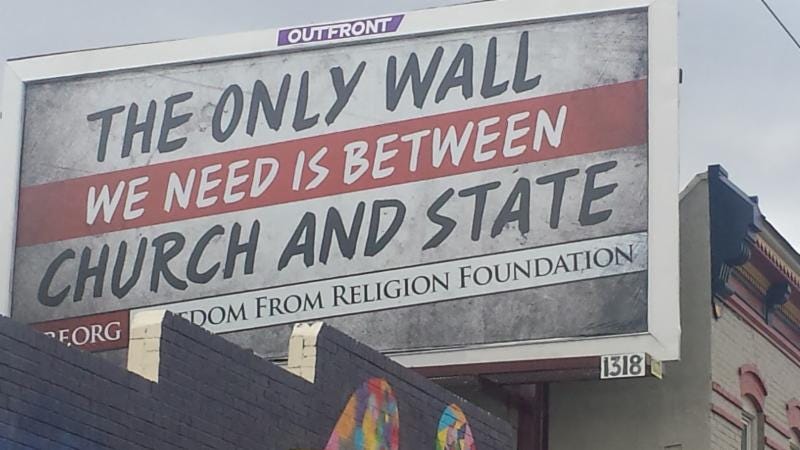
The wall of separation has long been a feature of American society. It provides equal safeguards for freedom of as well as freedom from religion. But the Trump regime has adopted the Heritage radical platform for a Christian nationalist theocracy and has installed religious fundamentalists throughout the government, including the judicial, legislative and executive branches.
Liberty is one of the four REAL wellness dimensions. Liberty includes personal freedoms, including not only of but as well from religion. We in America are as free not to believe in any gods as we are to embrace any one of them, none priviledged over the others. Well, at least in theory and in accord with the Constitution, at least until now.
Nobody can be compelled to engage in prayers or any religious rituals. Government functions are supposed to be secular and your tax dollars must not be used to support a faith system or institution. to support religious institutions, Your children and everyone else’s must never be compelled to participate in religious activities in public schools, nor be affected by policies based upon religious dogmas or beliefs.
These statements do not represent hostility toward religion but rather a desire not to be compelled to support or be part of it, if one chooses not to be. The distinction is often lost on the devout, who conflate an include me out position as one of opposition to or even hostility toward religion itself.
Perhaps, over time, the influence of Trump and the theocratic Republican Party will diminish, but only if citizens recognize the value of the Constitution’s Establishment Clause and protest the myriad violations of the Trump regime.
Religions
There are half a dozen or so major religions with millions of followers in America, all with different ideas about what a deity wants from us and what we must do to please him, her or it. Within each religion, there are denominations, sects or factions , many as different from each other as each religion is from the others. Worship routines vary, dogmas are diverse and explanations of why we’re here and what happens when we die are all over the imaginary maps created by believers over time.
Explain a sect or offshoot of any religion, such as fundamentalist Christianity, to a sentient adult not indoctrinated from childhood in the belief system and what kind of reaction would you expect? The word gobsmacked comes to mind. For secularists, and others, as well, this diversity is a good thing, preventing a single religion from taking over the state, such as in countries like Iran, Saudi Arabia and so many others. That is, until now, with Christian nationalists focused upon and tolerant only of their own beliefs.
One reason we have a wall of separation still, more than two centuries after the Founders set down our Constitution’s foundations, is because believers have not joined forces. If they did, secularists would have little chance. The fact that religious factions like each other even less than they like the non-religious discourages them from controlling everything.
My Experience with Religion
All religions seem strange to the religious, except their own. This is quite understandable, since all religions are strange, with the possible exception of Scientology. Ha ha—kidding. Full disclosure: While not a dues-paying member of either, I am partial to three theatrical religions—Pastafarianism (also known as the Church of the Flying Spaghetti Monster), Frisbeetarianism, whose adherents believe that the soul of the departed ascends to a roof after death and the Satanic Temple, which advocates reason and empathy.
I was indoctrinated in a foreign-based religious cult, Roman Catholicism. I was too young to object or resist baptism in this religion; my parents just assumed that, of all possibilities, I preferred to be a Roman Catholic. As best I can recall, the religion had quite a few required belief features:
A personal God who created the universe in less than a week. Seemed reasonable when first notified of this—my understanding of physics during pre-school and the elementary grade years left much to be desired. Humans were initially made of dust, I was told, except women, who were constructed from a male body part.
The first male and female had a nice situation until they were tempted by a bad actor called the Devil, who tricked them unto eat an apple that was off limits. They had been living the good life in a Garden of Eden without benefit of clergy when they ate the forbidden fruit. I can’t recall why this particular apple was forbidden—maybe God wanted it for himself, I dunno. Anyway, for eating this one apple they had to leave the nice garden, for parts unknown. Oh, and there was a talking snake involved.
After about fifteen hundred years, God was angered again by the wickedness of mankind, so he drowned everybody in the whole wide world, except eight people and a boatload of pairs of every living creation—fish, reptile, amphibian and bird. (As noted, it was a huge boat that probably had an advanced sanitary system and a warehouse of delectable foodstuffs for every taste.)
Long after things settled down, a new population turned out to be sinners, too, so God dictated a rule book called the Bible. In this book, every word was true.
At this point or maybe after many new points, God decided to come down himself and set things right. But, in disguise, as a baby. When God grew up, he became a preacher, and did things humans can’t do, like raise the dead, walk on water, replace a severed ear good as new, heal ten lepers, the servant of a Centurion, restore the sight of a pagan named Bartimaeus, expel demons from a guy possessed in Gerasene and in other ways perform mind-boggling feats, so good they were called miracles. Despite this, he was murdered. However, he only stayed dead for a few days before deciding to go back to heaven.
As the above story unfolded, it turned out that God’s death was intentional, a suicide, basically, because he deliberately goaded the ruling Romans. His plan was to make a self-sacrifice for the sins of all humans, including those not even born yet.
I recall having difficulty following this by about the third or fourth grade.
The part I remember best was the message, repeated daily by uniformed females who dressed like women in Iran, Saudi Arabia and Afghanistan, who convinced us
Catholic toddlers that dying with a mortal sin on soul, a burden incurred by missing Mass on Sunday, my soul would go straightaway to a red hot dungeon of eternal pain.
Ingersoll on the Hold of Religion
As you might expect, not all Christians take this mythology literally. In fact, except for fundamentalists, most believers probably don’t dwell at all on most of the foundation themes. Just the same, Christians usually say they believe these things, more or less. They certainly did so in 1881, when Robert Green Ingersoll, in a debate with another lawyer named Jeremiah S. Black, offered this view:
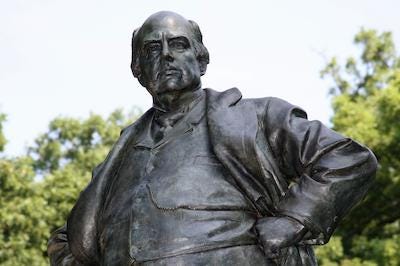
A vast number of people not only believe these things, but hold them in exceeding reverence, and imagine them to be of the utmost importance to mankind. They regard the Bible as the only light that God has given for the guidance of his children; that it is the one star in nature’s sky—the foundation of all morality, of all law, of all order, and of all individual and national progress. They regard it as the only means we have for ascertaining the will of God, the origin of man and the destiny of the soul.
Well, believe like that and it’s no wonder that Trump’s biblical literalists want to tear down the wall so that religion and government will meld into some kind of Valhalla on Earth for the greater glory, for the will of God and the destiny of souls.
Oh boy, it’s going to be a struggle. Unless those who believe in reason and science and the wealth of exuberances available in this life make a stronger case for looking after that priceless wall of separation, we might lose the liberty we enjoy today.
Let’s do all we can to raise up judges and elected officials willing and able to repair, protect and elevate the wall everyone should favor, the one that separates church and state.